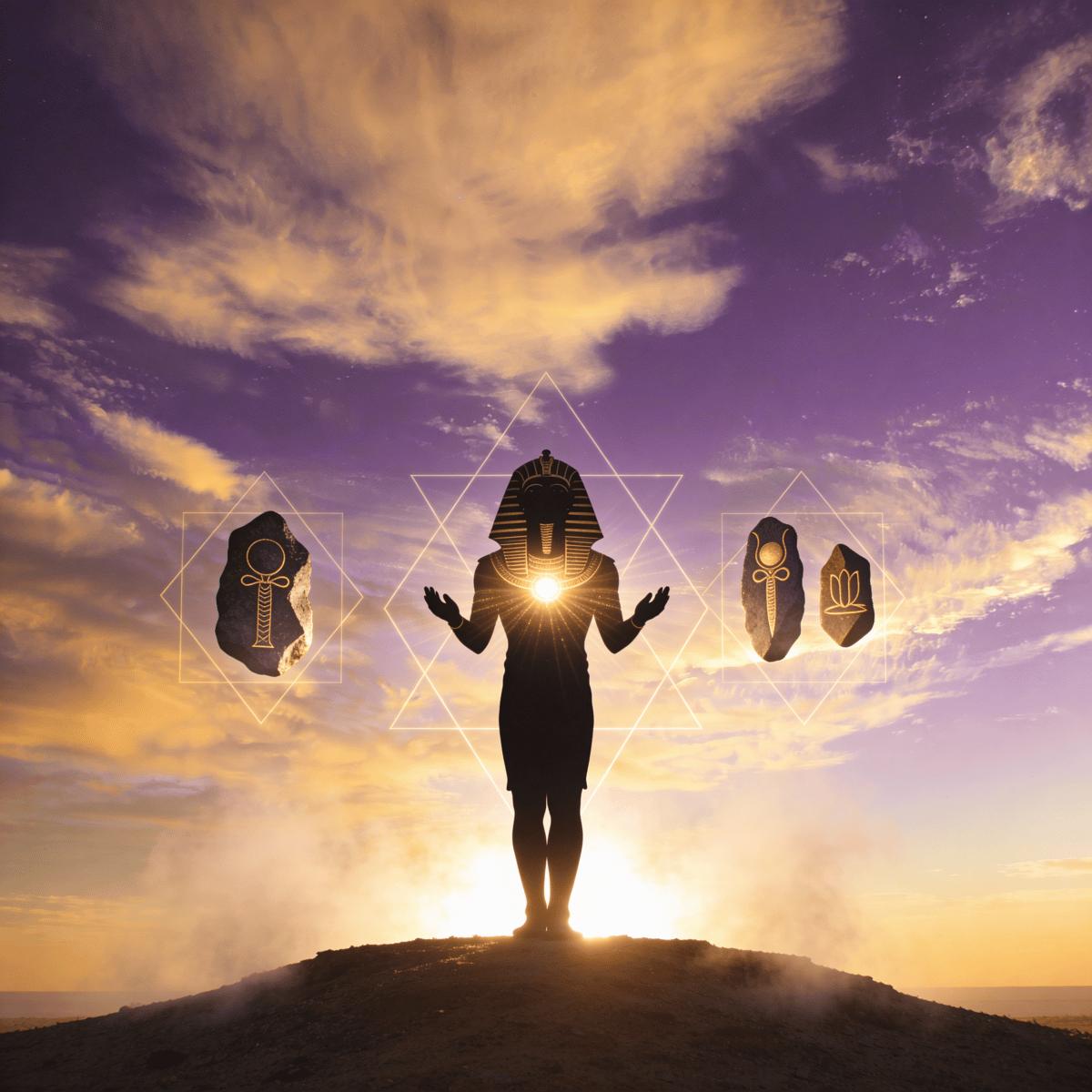

Sekhem—The Innate Power of Divinity
Studying the Medu Neter can give the student the innate power complex to perceive the true divinity of Ancient Kemetic spirituality on a level that isn’t taught in schools. It is a sacred science, once relegated to stuffy academic studies—now more people have access to what was once gatekept.
This is what I call the Ka—Sekhem—Heka power complex. A triangular shaped relational construct of esoteric philosophy.
‘Sekhem’ means power in Middle Egyptian. It is a key component of the ancient understanding of energy that you may have never heard of.
The people of Ancient Kemet had different words for ‘power’ such as ‘Peheti’ and ‘Khapesh.’ Sekhem, however, wasn’t just an Earthly representation of power—Sekhem was cosmic power and authority.
We all have sekhem within us. This is because sekhem is the vital essence that powers us in the form of active energy. If the Ka is passive, stored energy—then sekhem is active energy that can be used with Heka magic.
The Ka and sekhem go hand-in-hand. If your Ka is weak and malnourished, then so too will you have weak sekhem. Weak sekhem means weak Heka.
Ka—>Sekhem—>Heka
Stored Energy—>Active Energy(Power)—>Magical Potency
The Sekhemti—The Double Crown of Divine Power

An artistic rendering of a Pharaoh wearing the sekhemti crown and wielding the sekhem scepter.
Pictured in the thumbnail at the top of this article is a depiction of a Pharaoh wearing what is often simply called ‘the double crown’ of Lower and Upper Kemet.
I’m not a fan of this phrasing because it removes the sekhem—the power—that the crown represents. The double crown had a couple of different names, and one of those names was Sekhemti. Meaning it was more than just a double crown representing two different regions. It was a cosmic and magical representation of divine power. An expression of the Ka-Sekhem-Heka power complex.
Wearing the Sekhemti meant you had the power over not only life itself within the nation, but nature itself. That is how the Pharaohs moved in this world.
The Pharaoh is also depicted holding the sekhem scepter—a tool that reflected his power on Earth. I imagine it was believed that to hold the scepter gave the wielder the power to control life itself on both sides of the veil—in the physical and non-physical domains.
The problem with Egyptology is it has removed the spiritual understanding of Ancient Kemet. Kemet was a magical society, everything had dual meanings and a spiritual essence.
While regular people couldn’t use their sekhem for rulership, they could use it in their daily rituals and esoteric practices as they worked with the Neteru. When they prayed to the Neteru, they used sekhem.
Sekhmet—Goddess of Divine Power

An artistic rendering of the Goddess Sekhmet on the banks of the Nile River
Sekhmet’s (or Sekhemet) very name evokes divine power as the word ‘sekhem’ is the root of it. She is often described as a solar, warrior Goddess who is the wife of Ptah—a divine consciousness and creator God that I have written about in the past.
Being the Goddess of Divine Power is probably why she is depicted as fierce and deadly and given the face of a lioness.
The relationship between power (Sekhmet) and creation (Ptah) cannot be overlooked. Creation, especially on a cosmic scale, is the wielding of divine power. However, even small and mundane acts of creation cannot be ignored either. This relationship implies that all acts of creation requires some level of divine power.
I know that concept is hard to imagine in a post-industrial world dominated by scientific dogma. However, even the Kybalion says “as above, so below. As within, so without.” Whatever is reflected in the cosmos, can be seen even on the quantum level. So if Ptah Consciousness required sekhem to create the universe, so too do we require it to create within the physical construct.
This opens up the door to a massive re-understanding of manifestation. Manifestation is nothing without sekhem energy. Life force essence—chi (as the taoists would call it).
The Ka and Heka—Beginning and End
The Ka and Heka are the alpha and omega of the power complex. With sekhem being the binding power that links the two.
Heka magic requires energy. This energy comes from the practitioners own stored energy supply—his/her own Ka. The people of Ancient Kemet believed that the Ka needed to be fed on a daily basis. So there’s even a relationship between the Ka and the body itself.
A healthy body = a healthy Ka. This is not just true regarding the food we eat and the liquids we drink, but also our conditioning. Our mental and physical condition impacts our Ka (our potential/stored energy).
Our Ka energy is converted to Sekhem. So in a way, sekhem is really just Ka energy in action.
We cannot live without our Ka. The minute our bodies are depleted of Ka, we are depleted of life. It is the animating force of our bodies. It keeps us alive, but it doesn’t directly power our Heka magic. That is the role of sekhem.
This is ultimately why shadow work and spiritual hygiene are critically important because both play a role in how effective you can be at converting Ka energy into sekhem power.
Heka, therefore, is the product. It is the end result.
The Ka—>Sekhem—>Heka power complex is very real. I am now treating understanding it as fundamental to Kemetic spirituality.
Up Next: The Utterance of Sekhem
So to not make this article too long, in the next article I will be providing a new divine utterance—the Utterance of Sekhem.
Its purpose will be to convert your Ka energy into sekhem to be used in your magical practices. This will actually pair well with the Sha Talisman.
